
If you’re an artist who sells your work on the internet, people will try to steal it and sell it as if it was their own work. What I didn’t expect is that AI would be trained on my artwork, and then modified versions of my work would then be sold and passed off as someone else’s. I wouldn’t even have expected this to happen to me had I not made an unrelated social media post advising AI users to do an inverse image search so they’re not accidentally violating someone else’s intellectual property (IP) rights.
After making my post, I received pushback from people defending the “originality” of AI. Random people on the internet were *shocked* that AI could possibly be used as a tool to facilitate an intellectual property crime. I was pretty shocked that so many people don’t realize this. I just assumed everyone knows that AI is trained on other people’s artwork, and IP violations are a well-documented thing.
Then I remembered an instance of IP violation of my own work where a company decided to steal my work, modify it, and use it on all of their products. I will use a made-up name to refer to the infringing company as “Bogus Wonder” (I don’t want shame them by using their real name as I’m sure they didn’t knowingly violate my intellectual property rights). I initially thought Bogus Wonder got an armature artist to remove the head from my Honey Badger illustration and replace it with a cartoon head. But, upon closer inspection, I have reason to believe that Bogus Wonder decided to completely forgo hiring an artist and just use AI without doing an inverse image search.
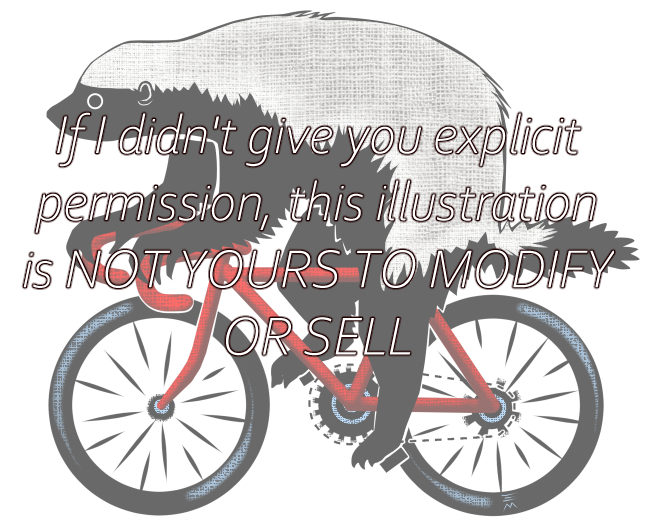
The first image you see is my image. This is my “Honey Badger on a Bicycle” illustration. I have not given anyone permission to modify, use, or sell this image:

This second image below is the one I discovered Bogus Wonder using as their logo and on all of their merch and website:

How do I know this image was created using AI? Well, I can’t 100% say for sure. But I did notice the odd AI thing that you’ll commonly find. I pointed it out with the red arrow in the above image. Any self-respecting artist would know how to draw a ‘partial head turn’ of a cartoon character’s face. AI wouldn’t understand where to place the ear, so it would likely attach it to the face (as presented in the poorly drawn cartoon head modification of my work).
Seven days after I sent Bogus Wonder a cease-and-desist letter, they updated their merch labels and some images on their Facebook page. They still have yet to take down all of my images and pay me what they owe for using my image.

I created and began selling my Honey Badger illustration on my Zazzle site in 2018. Dall-E wasn’t released until 2021, and I didn’t start incorporating AI into my workflow until sometime 2024.
That means I hand-drew this Honey Badger on a Cintiq and put in a lot of time crafting all of the individual tufts and texture in her fur. I also spent a lot of time designing her delicate fingers and in getting the proportions of her body, arms legs and tail just right. If someone wants to turn a profit from my hard work, they would first need to reach out to get written permission to use my work.
In spite of all this, I do find AI to be a useful tool. However, it never gives me exactly what I want, and I usually end up spending a lot of time correcting and modifying what AI produces for me. I’m not too concerned yet that AI will replace actual artists (yet). Most of what it produces is amateurish or concepts that need modification and the professionalism of work and style is random.
Thanks for reading.
Leave a Reply